LDAP Detection Rules Fail Due to Whitespace Issues
SeverityHIGH

High severity — significant development or major threat actor activity

Featured image for LDAP Detection Rules Fail Due to Whitespace Issues
HNHuntress Blog
Summary by CyberPings Editorial·AI-assisted·Reviewed by Rohit Rana
Updated:
🎯

Basically, LDAP rules that work in testing don't work in real life because of extra spaces.

Quick Summary

LDAP detection rules are failing in production due to whitespace issues. This affects organizations relying on LDAP for security. It's crucial to fix these rules to avoid missing critical alerts.

What Happened

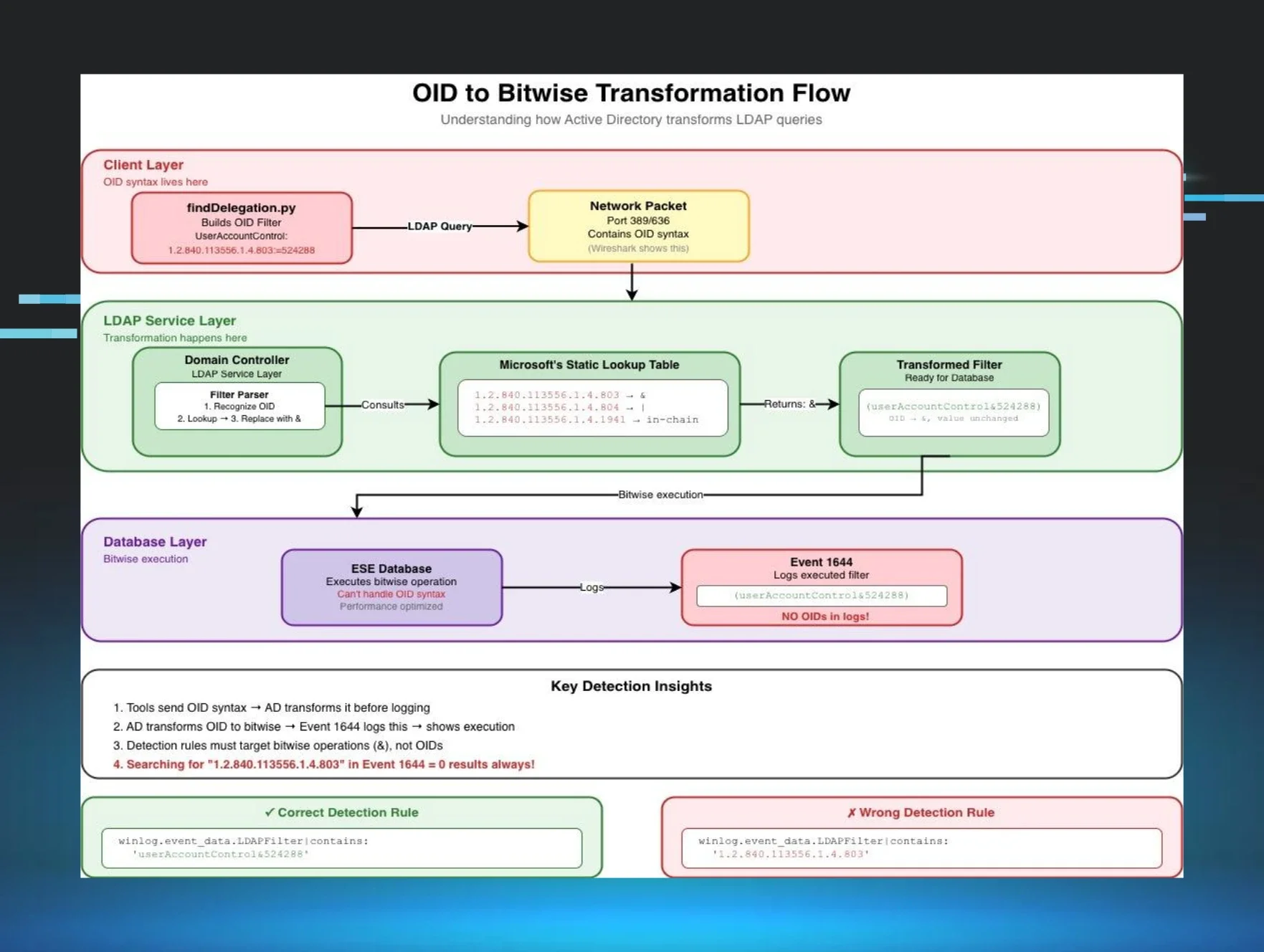
Have you ever set up a system that works perfectly in testing, only to have it fall flat in the real world? This is happening with LDAP detection rules, specifically with Event 1644, where whitespace variations are causing significant issues. These rules might seem effective during lab tests, but when deployed in production, they often fail to trigger alerts as expected.

The problem arises from how different systems interpret whitespace. In a lab environment, you might have controlled inputs, but in production, the data can come from various sources, leading to unexpected whitespace characters. This inconsistency can break the logic of your Sigma rules, rendering them ineffective when you need them most.

Why Should You Care

Imagine relying on a security system that fails to detect a threat because of something as simple as extra spaces in the data. This could leave your organization vulnerable to attacks, as malicious activities might go unnoticed. If your company relies on LDAP for authentication or directory services, this issue is even more critical.

Think of it like trying to read a sentence with random spaces inserted — it becomes confusing and may lead to misunderstanding the message. In the same way, your detection rules can misinterpret important security events, putting your data and systems at risk. You need to ensure your detection rules are robust enough to handle real-world data variations.

What's Being Done

Experts are actively working on solutions to address the LDAP whitespace problem. Here are some immediate steps you can take:

  • Review your Sigma rules and ensure they account for whitespace variations.
  • Test your detection rules in a production-like environment to identify potential failures.
  • Update your systems to handle different whitespace characters effectively.

Security professionals are closely monitoring this situation, as more organizations face similar challenges with their detection rules. Keeping your systems updated and vigilant will be crucial as you navigate these complexities.

🔒 Pro insight: Addressing whitespace variations in Sigma rules is vital for maintaining effective security posture in dynamic environments.

Original article from

HNHuntress Blog
Read Full Article

Related Pings

MEDIUMTools & Tutorials

METATRON - New AI Tool Enhances Penetration Testing on Linux

A new open-source tool called METATRON is revolutionizing penetration testing. Designed for Linux, it uses AI to assess vulnerabilities offline. This ensures sensitive data remains secure, making it ideal for professionals.

Cyber Security News·
LOWTools & Tutorials

Proton Authenticator - End-to-End Encrypted 2FA App Explained

Proton Authenticator is a new open-source 2FA app that enhances online security. It generates time-based passwords and offers encrypted backups for user data. This app ensures privacy without ads or tracking, making it a reliable choice for securing accounts.

Help Net Security·
LOWTools & Tutorials

Best User Access Management Tools - Top Picks for 2026

Explore the best user access management tools for 2026! These tools enhance security and streamline user permissions, helping organizations protect sensitive data and ensure compliance.

Cyber Security News·
LOWTools & Tutorials

Elastic Security - Nine New Integrations Announced

Elastic Security Labs just launched nine new integrations! These tools boost cloud security, endpoint visibility, and email threat detection, helping teams respond to threats faster.

Elastic Security Labs·
MEDIUMTools & Tutorials

6 Critical Mistakes Undermining Cyber Resilience Explained

Organizations often make critical mistakes that weaken their cyber resilience. This article outlines six key errors and how to fix them for better security. Don't let silos hold you back.

CSO Online·
MEDIUMTools & Tutorials

CoBRA - Simplifying Mixed Boolean-Arithmetic Obfuscation

CoBRA simplifies Mixed Boolean-Arithmetic obfuscation, helping security engineers analyze malware and software protection schemes. It boasts a 99.86% success rate, making it a powerful tool in the cybersecurity toolkit. Available as a CLI tool, C++ library, and LLVM pass plugin.

Trail of Bits Blog·